Fractional CTO For Startups: Ship Faster, No Rewrite
SeeSaw Labs//8 Min Read
How a fractional CTO helps startups ship faster without future rewrites, with MVP guardrails, delivery cadence, and practical execution steps.

Shipping fast is only a win if you can keep shipping.
The painful version of “fast” is when your MVP gets traction, then progress slows to a crawl because every feature breaks something, infrastructure costs skyrocket, and the team starts whispering the word “rewrite.”
A fractional CTO for startups helps you move quickly with guardrails, so you can validate the market now and still have a product you can scale without rebuilding from scratch.

Table Of Contents
- Why Startups End Up Rewriting After Shipping Fast
- What A Startup Fractional CTO Actually Does Differently
- The “Ship Faster Without Rewrite” Playbook
- Fractional CTO For MVP Development: The Quality Bar That Matters
- A Realistic 30 60 90 Day Plan
- How SeeSaw Labs Helps Startups Ship Faster
- FAQs
- Conclusion
Why Startups End Up Rewriting After Shipping Fast
A rewrite is rarely caused by one bad technical choice. It is usually a pattern: rushed decisions, unclear boundaries, and no shared record of why things were built the way they were.
Technical Debt Becomes “Interest” You Cannot Pay
Technical debt is a metaphor for future cost created by choosing speed today, and the “interest” shows up as slower changes later.
Healthy startups take on some debt intentionally. The rewrite trap happens when debt is invisible, untracked, and concentrated in the foundations: data model, auth, core workflows, and deployment reliability.
The MVP Was Built Without Guardrails
Many MVPs ship without basics that keep iteration safe:
- Automated deploy pipeline
- A simple testing strategy
- Error monitoring and logs
- Clear API contracts
- A stable data model boundary
The result is not just bugs. It is fear. Teams slow down because every release feels risky.
Decisions Live In People’s Heads
When architecture decisions are not written down, teams re-litigate the same debates, repeat mistakes, and lose context as people change. Architectural Decision Records are a lightweight way to document the decision, its context, and consequences.
What A Startup Fractional CTO Actually Does Differently
A fractional CTO role is not about doing more work, it is about removing the specific friction that makes shipping slow.
Here are the fractional CTO responsibilities that most directly increase speed while reducing rewrite risk:
They Turn Goals Into A Delivery System
A strong fractional CTO connects business outcomes to an executable plan, then keeps delivery honest with simple check-ins and clear ownership.
They Set “Good Enough” Architecture Early
Startups do not need enterprise architecture. They need the right boundaries so the MVP can evolve:
- Clear domain model boundaries
- Modular services where it matters
- Scalable defaults for auth, data, and infrastructure
They Create Decision Velocity Without Chaos
This means:
- Defining who decides what
- Setting a cadence for tradeoffs
- Logging decisions so the team can move on
They Protect The Team From Tool And Vendor Sprawl
Choosing tools is easy. Paying for them forever is not. Fractional CTOs often reduce waste by simplifying stack decisions and vendor overlaps.
The “Ship Faster Without Rewrite” Playbook
If you are evaluating a fractional CTO for startups, this is what you should expect them to install.
Align On The Thin Slice MVP
Shipping faster starts with reducing scope without reducing learning.
- Define the core user journey
- Cut everything that is not required to validate it
- Decide what you will measure after launch
Add Guardrails That Preserve Speed
These are high leverage foundations that keep iteration cheap:
- CI/CD so releases are routine
- Basic automated tests around core flows
- Monitoring and error tracking
- Data migrations handled intentionally
When these are missing, speed collapses later.
Use A Decision Log For High Impact Choices
ADRs are a practical format for decisions that affect future flexibility, like data model strategy, API style, and hosting choices.
Track Delivery Health With A Few Metrics
DORA metrics are widely used to measure delivery speed and stability, including lead time and change fail rate.
Create A Tech Debt Budget
Not all debt is bad, but it must be visible:
- What debt did we take on to ship?
- What is the payoff plan?
- What debt is now blocking feature speed?
This is how you avoid waking up six months later with a product nobody wants to touch.
Fractional CTO For MVP Development: The Quality Bar That Matters
Founders often hear “MVP means scrappy,” then discover that scrappy can also mean fragile.
Here is a realistic quality bar that keeps you fast now and scalable later:
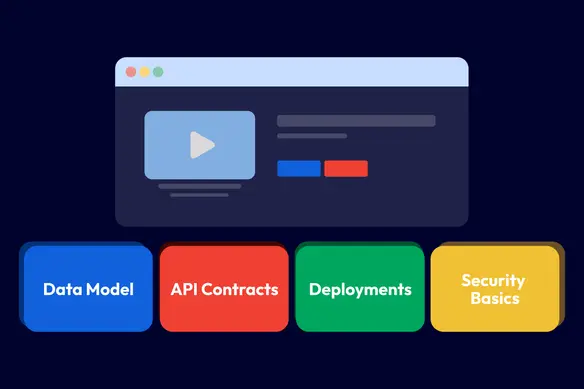
| MVP Area | “Fast But Safe” Standard | What It Prevents |
|---|---|---|
| Core Data Model | Clear ownership of key entities and migrations | Data rewrites, broken reporting |
| API Contracts | Versioning or stable contracts for core flows | Frontend rework, integration failures |
| Deployments | Automated deploy with rollback path | Release fear, long launch cycles |
| Observability | Logs, error tracking, basic alerts | Debugging black holes |
| Security Basics | Authentication patterns, access control decisions | Risky rework under pressure |
| Documentation | ADRs for major decisions | Repeating debates, lost context |
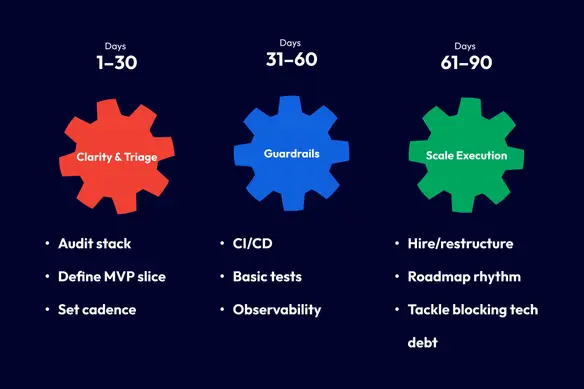
A Realistic 30-60-90 Day Plan
This is a practical way a startup fractional CTO can create momentum without overengineering.
Days 1 To 30: Clarity And Risk Triage
- Audit the product, stack, and delivery workflow
- Identify the top constraints slowing shipping
- Define the MVP slice and success metrics
- Establish decision rights and a weekly cadence
Days 31 To 60: Install Guardrails
- CI/CD and release discipline
- Basic testing around the most expensive failures
- Observability and incident basics
- First round of ADRs for core decisions
Days 61 To 90: Scale Execution
- Hire or restructure roles so delivery does not bottleneck
- Create a predictable roadmap rhythm
- Reduce tech debt that is actively blocking iteration
- Tighten security and reliability where customers will feel it
This is the kind of structured approach SeeSaw Labs describes across its fractional CTO and product delivery services.
How SeeSaw Labs Helps Startups Ship Faster
SeeSaw Labs frames Fractional CTO Services as embedded technical leadership that bridges business goals and engineering execution, covering architecture, hiring, security, and delivery management.
A big advantage for founders is the consistent process language SeeSaw Labs uses across offerings, including the 5D approach (Discover, Define, Design, Develop, Delight), which helps reduce ambiguity and keep progress measurable.
If your main blocker is capacity, not leadership, Staff Augmentation can pair with fractional CTO guidance so senior time stays focused on decisions and leverage.
FAQs
Is A Fractional CTO Only For Later Stage Startups?
No. Many early stage startups use a fractional CTO to choose the right stack, build an MVP safely, and hire the first key engineering roles without committing to a full time executive.
How Does A Fractional CTO Help Us Ship Faster?
They remove decision bottlenecks, tighten scope to the highest learning slice, install delivery guardrails, and create a predictable operating cadence so the team can execute.
What Are The Most Important Fractional CTO Responsibilities During MVP Development?
For MVP work, the most important responsibilities are architecture boundaries, delivery process, security basics, and prioritization that keeps the team focused on validation.
Will We Still Need A Full Time CTO Later?
Sometimes. A fractional CTO is often a bridge: they get you to product market fit, de risk scaling, and help you hire the right full time leader when the time is right.
How Do We Know If We Are Headed Toward A Rewrite?
Common signals are rising change fail rate, slow lead time, unclear ownership of core systems, and growing fear around releases. Tracking a small set of delivery metrics can surface this early.
Conclusion
A rewrite is not the price of speed, it is usually the price of shipping without guardrails.
The right fractional CTO for startups helps you move faster by making fewer wrong turns. They create decision velocity, focus your MVP on real learning, and put lightweight foundations in place so each release gets easier, not scarier.
Key Takeaways
- Ship faster by narrowing scope to the highest learning slice, not by cutting corners everywhere.
- Avoid future rewrites by installing lightweight guardrails early, including CI/CD, observability, and a basic test strategy.
- Document high impact technical choices with ADRs so decisions do not get re-decided.
- Treat technical debt like a budget with visibility and a payoff plan, not a silent backlog that compounds.
- If you want embedded leadership that ties roadmap, architecture, and delivery together, SeeSaw Labs’ Fractional CTO Services are designed around that operating rhythm.