Custom Healthcare Software MVP to Scale Roadmap
SeeSaw Labs//9 Min Read
A practical roadmap for custom software development for healthcare—covering MVP scope, HIPAA-aligned security, integrations, scaling, and ongoing support.

Most healthcare software projects do not fail because the idea is bad. They fail because the first version cannot safely survive success.
A pilot goes well, a provider group wants to roll it out, an enterprise buyer asks for security evidence, and suddenly the MVP looks like it was built on sand.
This roadmap shows how to build an MVP that proves value quickly, while laying the foundations for HIPAA-aligned security, integrations, and support that can scale.
What “MVP To Scale” Means In Healthcare
In many industries, an MVP can be rough. In healthcare, even the first release must be safe, auditable, and predictable, as it may affect patient trust, clinical workflows, and regulated data.
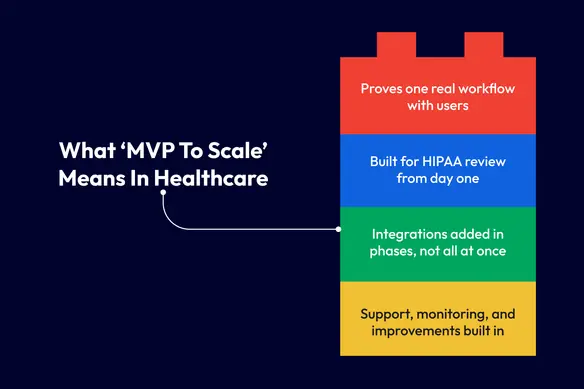
MVP to scale means:
- The MVP demonstrates one or two end-to-end workflows with real users.
- The underlying foundation (identity, access, logs, encryption, and deployment) is built to be reviewed. Because it probably will be.
- Integrations grow in phases, not all at once, so complexity does not crush delivery.
- Support is built into the product, including monitoring and continuous improvement.
Phase 0: Discovery And Scope That Will Not Break Later
This is where you protect your timeline and your budget.
Define The One Workflow You Will Win First
Pick a narrow outcome and make it measurable.
Examples:
- Reduce intake time by 30 percent for a specific visit type.
- Cut referral leakage by improving scheduling follow-through.
- Decrease claims denials by improving data completeness.
Then, map the workflow step by step with the people who do it today.
Draw The Data Boundary Early
Before anyone estimates effort, clarify:
- What data is created, stored, or shared?
- What is considered ePHI in your system?
- Who needs access, and at what privilege level?
If you handle ePHI in the US, HIPAA’s Security Rule establishes standards for safeguarding it, and those safeguards influence product design from day one.
Decide The Integration Strategy Up Front
Many teams underestimate integrations, treating them as “just an API.”
In healthcare, integrations often require:
- Data mapping and normalization
- Workflow alignment (what happens when the EHR rejects an update?)
- Security and auditability
- Phased rollout to reduce clinical risk
If interoperability is in your roadmap, build a shared understanding internally around what it means and why it matters.
Phase 1: Build The Healthcare MVP With A Secure Core
Your MVP should feel simple to users, while being disciplined under the hood.
MVP Features That Usually Belong In The First Release
Most healthcare MVPs need:
- Authentication and session management
- Role-based access control that matches real job roles
- Audit logging for key actions
- Secure data storage and secure transport
- The one core workflow that proves value
- Basic reporting or operational visibility
This aligns with the practical advice many SaaS healthcare MVP checklists emphasize: keep it clear, safe, and testable, and build on a strong identity and audited access.
HIPAA Aligned Security Foundations
HIPAA does not specify which tools to use, but it does describe the administrative, physical, and technical safeguards that regulated entities must implement.
To translate that into buildable MVP foundations, teams commonly prioritize:
- Access control and least privilege
- Audit controls
- Encryption in transit and at rest
- Secure backups and recovery
- Monitoring and incident response readiness
A helpful, practical reference many teams use alongside HIPAA is NIST SP 800-66 Rev. 2, which provides guidance on implementing the HIPAA Security Rule.
Phase 2: Pilot Release And Validation In Real Workflows
This is where healthcare apps become real, and where assumptions get corrected.
What A Good Pilot Proves
A pilot should validate:
- Real workflow fit (not demo fit)
- Data quality and error handling
- Performance under real network conditions
- Audit trail completeness for key events
- Support readiness (alerts, triage, rollback plan)
Healthcare testing is different because bugs can cause harm, and testing must simulate real clinical edge cases.
Security And Privacy Checks Before Expansion
Before you roll out beyond a pilot:
- Run a security review and fix high-risk issues
- Confirm your logging supports the investigation
- Validate that only authorized roles can access sensitive data
- Make sure your incident response path is clear
If a breach occurs, the HIPAA Breach Notification Rule requires covered entities and business associates to notify the Secretary of Health and Human Services and affected individuals following a breach of unsecured protected health information. This is another reason to build investigation-ready logging early.
Phase 3: Scale Integrations Without Rewriting Everything
Scaling usually means adding integrations. Integrations usually mean complexity.
Prioritize Integrations By Risk And Value
A practical order often looks like:
- Identity and access (SSO, directory)
- One clinical data source (EHR or lab)
- One outbound channel (patient messaging, care plan delivery)
- Then expand breadth (more sites, more systems)
Use Standards Where They Fit
FHIR is a standard for exchanging healthcare information electronically, and it often becomes central when integrating with modern EHR APIs.
Also, keep an eye on interoperability expectations influenced by the 21st Century Cures Act and information blocking policy, especially if patient access and data sharing are part of your product strategy.
Phase 4: Enterprise Readiness (Security, Reliability, Evidence)
This is the stage where buyers ask for proof.
Reliability And Operations
Enterprise readiness typically includes:
- Defined uptime goals and error budgets
- Monitoring and alerting tied to user-impacting failures
- Disaster recovery planning and tested backups
- Change management and release controls
- Access reviews and audit review processes
Evidence For Procurement
Depending on your buyers, you may need:
- Security documentation and control mapping
- Vendor risk questionnaires
- Third-party testing results
- A clear story around how you align to HIPAA safeguards, supported by practical guidance like NIST SP 800-66
This is also where many teams begin preparing for SOC 2 expectations, especially when selling to enterprise customers.
Phase 5: Ongoing Support And Continuous Improvement
Support is not just bug fixes. In healthcare, it is about maintaining trust.
A mature support plan includes:
- Monitoring, alerting, and on-call response
- Incident response drills and post-incident reviews
- Patch cadence for dependencies and infrastructure
- Ongoing performance tuning
- Feedback loops with users and phased improvements
If you are partnering with a development team, confirm that post-launch support is a real offering, including maintenance, monitoring, and continuous improvement plans.
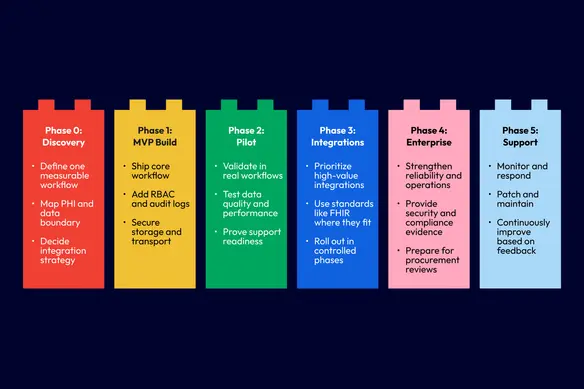
MVP To Scale Roadmap Table
| Phase | Main Goal | What You Ship Or Prove | What Buyers And Security Teams Want To See |
|---|---|---|---|
| Phase 0: Discovery | Reduce risk early | Workflow map, data boundary, integration plan | Clear scope, identified compliance triggers |
| Phase 1: MVP Build | Prove value safely | Core workflow, RBAC, audit logs, secure storage | Safeguards designed in, not bolted on |
| Phase 2: Pilot | Validate in reality | Pilot release, UAT results, performance learnings | Testing in real scenarios, incident readiness |
| Phase 3: Integrations | Expand capability | Phased EHR and third-party integrations | Standards approach (FHIR), controlled rollout |
| Phase 4: Enterprise | Prove reliability | Monitoring, DR, security evidence | NIST-informed security mapping, procurement readiness |
| Phase 5: Support | Stay trusted | Maintenance plan, response playbooks, improvements | Continuous improvement and operational maturity |
Choosing A Partner For Custom Software Development For Healthcare
When you are buying custom software development for healthcare, you are buying decision quality as much as engineering.
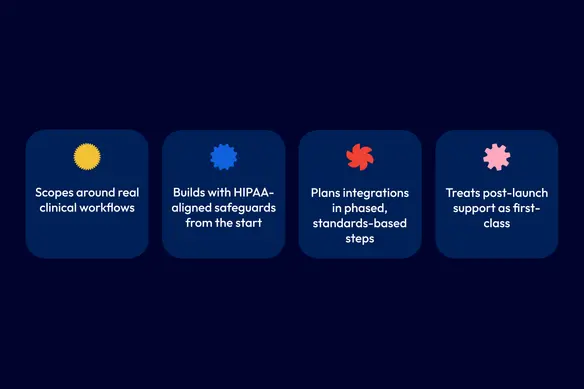
Look for a partner who can:
- Scope around real workflows and measurable outcomes
- Build with HIPAA-aligned safeguards from the start
- Plan integrations in phases, using standards like FHIR when appropriate
- Treat post-launch support as a first-class responsibility
SeeSaw Labs positions its custom software development practice around scalable, secure architecture, integration development, HIPAA and SOC 2 considerations, and ongoing support through maintenance and monitoring, which aligns well with the MVP-to-scale reality in healthcare.
If you want related internal reading for buyers and stakeholders, SeeSaw Labs also has practical guides on launching healthcare products and healthcare interoperability.
FAQs
What Is Custom Software Development For Healthcare?
It is the design, build, and support of software tailored to healthcare workflows, often involving sensitive data, integrations, and regulatory expectations that require stronger security and testing discipline than typical apps.
Can An MVP Be HIPAA Compliant?
HIPAA compliance is an organizational outcome, not a feature switch. That said, an MVP can be built with HIPAA-aligned safeguards such as access controls and audit controls, and guided by resources like NIST SP 800-66 to implement Security Rule concepts in practice.
What Integrations Should We Do First?
Start with the integrations that remove the most manual work with the least risk, often identity and one primary clinical data source. Expand in phases to avoid integration complexity stalling delivery.
Do We Need FHIR For EHR Integrations?
Not always, but FHIR is commonly used for modern healthcare data exchange and is frequently expected for EHR API strategies.
What Should We Plan For After Launch?
Monitoring, incident response readiness, security patching, and continuous improvement should be planned before launch, because support is part of patient and buyer trust.
Conclusion
Building an MVP is not the hard part. Building an MVP that can safely scale, integrate, and survive procurement is where healthcare teams either gain momentum or get stuck rebuilding.
If you treat security, integrations, and support as roadmap items from the first sprint, you reduce rework, shorten enterprise sales cycles, and build trust with users who do not have time for unreliable tools.
Key Takeaway
- Define the scope of a single measurable workflow and draw the PHI boundary early.
- Build the MVP on secure foundations: identity, access control, audit logs, and encryption aligned to HIPAA safeguards.
- Pilot in real workflows and test like patient safety depends on it, because it can.
- Scale integrations in phases, using standards like FHIR where they fit, and stay aware of interoperability expectations.
- Treat support as part of the product: monitoring, maintenance, and continuous improvement are what keep healthcare software trusted after launch.